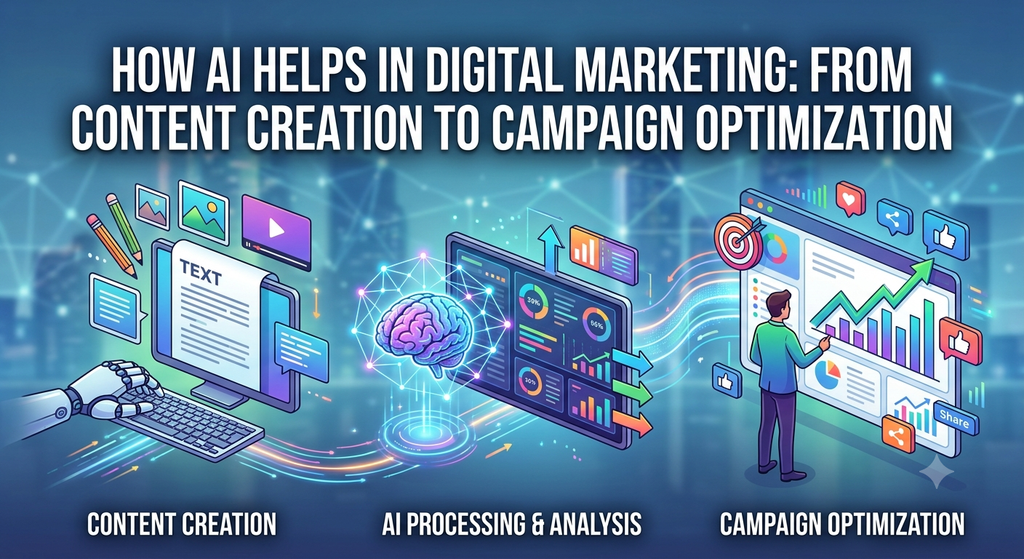
How AI Helps in Digital Marketing: From Content Creation to Campaign Optimization

How AI Helps in Digital Marketing

What is AI in Digital Marketing?

AI in digital marketing means using artificial intelligence to help businesses understand customers, automate marketing tasks, create content and suggestions, and improve advertising results.

For example, AI can analyze customer behavior and help marketers decide what content to show, who to target, and when to reach them for any website or APP.

Common uses of AI include:

  • Content creation: Writing social media posts, emails, blog posts, and ad copy.
  • Chatbots: Answering customer questions automatically.
  • Personalization: Recommending products or content based on a customer’s interests.
  • Advertising: Helping optimize audiences, budgets, and ad campaigns.
  • Data analysis: Finding patterns in website traffic, sales, and customer behavior.
  • SEO: Supporting keyword research, content optimization, and search-intent analysis.
  • Email marketing: Personalizing messages and helping determine effective timing and content.1

Example: An online clothing store can use AI to analyze what a customer has viewed or purchased and recommend products they may be interested in.

In short, AI in digital marketing = using intelligent software to make marketing more automated, personalized, and data-driven.

How AI will help in SEO

AI can help SEO by automating repetitive work, analyzing large amounts of data, identifying opportunities faster, and improving content quality. It doesn’t replace SEO strategy; it makes the SEO workflow more efficient.

AI could be helpful in the SEO work activities.

  • Keyword research and finding related keywords, entities, topics, and search intent
  • Search intent either queries by informational, commercial, navigational, etc
  • Content creation for creating briefs, outlines, drafts, and content variations
  • Content Optimization for identifying missing topics, entities, and semantic relationships
  • Title & Meta for generating and testing SEO title/description variations
  • Internal linking: implement and find relevant pages to link together
  • Technical SEO: finds and helps analyze large URL inventories and technical issues
  • For implementing programmatic SEO and helping generate structured metadata
  • Competitor Analysis: Analyzes competitors’ content and keyword coverage
  • GSC Analysis and finds patterns in clicks, impressions, CTR, and rankings
  • Content Refresh to identify outdated or declining content
  • SEO Reporting: Converts large datasets into actionable insights
  • Use of automation to connect SEO data with workflows

How AI Will Help in Content Creation Strategies

  • Find related search topics
  • Identify common questions users can ask
  • Group topics into a content cluster
  • Generate a content calendar
  • Create briefs for each article
  • Produce a first draft
  • Content headline suggestion based on SEO
  • Suggest SEO titles and meta descriptions.
  • Convert the article into social posts and an email

How AI Will Help in Social Media

AI is transforming social media marketing by helping brands create content faster, understand their audience, automate engagement, and optimize campaigns using data.

  • For content ideas to generate ideas based on trends, audience interests and past performance example: Suggests 20 Instagram/Reels topics
  • Caption Creation: Creates platform-specific captions
  • Content creation helps create images, videos, scripts, and creatives
  • Social Media Calendar builds content calendars based on campaigns and objectives; for example: Creates a 30-day posting plan
  • Audience analysis to identify audience interests, behavior, and engagement patterns
  • Implement personalization to create content for different audience segments
  • Scheduling helps determine suitable posting times; for example, it suggests publishing windows based on historical engagement
  • Ad Optimization Helps analyze audiences, creatives, and campaign performance
  • AI can help turn that single piece of content into an Instagram carousel, a 30-second Reel script, an X post/thread, or a YouTube Shorts script

How AI Will Help for Campaign Optimization

  • Audience targeting identifies audience segments based on behavior and interests
  • Audience segmentation identifies for groups users according to their characteristics and actions
  • Ad Creative Optimization analyzes different creatives and messaging Example: Identifies which headline/image combination performs better
  • Budget allocation helps identify where the campaign budget is producing better results
  • Bid optimization uses performance signals to adjust bids
  • A/B testing to generate and compare multiple campaign variations
  • Real-time monitoring detects changes in campaign performance
  • Conversion prediction uses historical signals to estimate conversion likelihood
  • Personalization matches messages to audience behavior
  • Cross-channel optimization compares performance across channels
  • Customer journey analysis finds where users drop off
  • Performance reporting turns campaign data into actionable insights

AI analyzes the campaign and finds that:

  • Creative A gets the highest CTR
  • Audience B generates more qualified leads
  • Campaign C has a lower cost per lead
  • Mobile users convert more frequently
  • Users who watch 50%+ of a video are more likely to submit a form

Looking for help on how to use AI in your digital marketing activities? Connect with our team at TrueSEOHelp

AI: Know everything about artificial intelligence

What is ai and what is ai definition?
AI stands for Artificial Intelligence. It refers to the simulation of human intelligence in machines that are programmed to think and learn like humans. The main goal of AI is to create computer systems capable of performing tasks that typically require human intelligence, such as understanding natural language, recognizing patterns, learning from experience, problem-solving, and making decisions.

Know everything about artificial intelligence

AI can be classified into two main categories:

  1. Narrow AI (Weak AI): This type of AI is designed to perform specific tasks and is limited to those tasks only. Examples include virtual personal assistants like Siri or Alexa, image recognition systems, and recommendation algorithms used by online platforms.
  2. General AI (Strong AI): General AI refers to a system with the ability to understand, learn, and apply knowledge across a wide range of tasks, similar to human intelligence. This level of AI does not yet exist and remains a theoretical concept for now.

The definition of AI is continually evolving as technology advances and researchers and developers make progress in creating more sophisticated and capable AI systems. The field of AI encompasses various subfields, including machine learning, natural language processing, computer vision, robotics, and expert systems, among others. AI has a broad range of applications across industries, including healthcare, finance, transportation, entertainment, and more.

What is one of the main key principles of responsible ai

One of the key principles of responsible AI is “Fairness.” Fairness in AI refers to the notion that AI systems should treat all individuals fairly and avoid any form of bias or discrimination based on characteristics such as race, gender, ethnicity, age, religion, or other protected attributes.

To achieve fairness in AI, developers, and researchers must be aware of the potential biases that can be introduced into AI systems during data collection, model training, and decision-making processes. It is crucial to ensure that the data used to train AI models is diverse, representative, and free from any inherent biases. Additionally, the algorithms and models themselves should be designed and tested to minimize disparate impacts on different groups.

By promoting fairness in AI, we can help prevent discriminatory practices and ensure that AI technologies are used ethically and responsibly to benefit everyone in society without reinforcing stereotypes or perpetuating inequalities. This principle is just one aspect of responsible AI, and other key principles include transparency, accountability, privacy, and security. Combining these principles helps guide the development and deployment of AI systems that align with societal values and respect the rights and dignity of individuals.

How does ai work?
AI works through a combination of data, algorithms, and computing power to simulate human intelligence and perform tasks that typically require human cognitive abilities. The process of how AI works can be broken down into several key steps:

  1. Data Collection: AI systems require vast amounts of data to learn and make informed decisions. Data can be collected from various sources, such as the internet, sensors, databases, and user interactions.
  2. Data Preprocessing: Before the data is used for training AI models, it needs to be cleaned, organized, and preprocessed. This step involves removing noise, handling missing values, and transforming the data into a suitable format for the AI algorithms.
  3. Machine Learning: Machine learning is a subset of AI that enables computers to learn patterns and make predictions from data without being explicitly programmed. There are different types of machine learning approaches, including:

a. Supervised Learning: The AI system is trained on labeled data, where each data point has a corresponding target or label. The algorithm learns to map inputs to outputs by minimizing the error between its predictions and the actual labels.

b. Unsupervised Learning: The AI system is given unlabeled data and must find patterns or groupings within the data without explicit guidance. Clustering and dimensionality reduction are common tasks in unsupervised learning.

c. Reinforcement Learning: The AI system learns by interacting with an environment and receiving feedback in the form of rewards or penalties. The algorithm aims to maximize the cumulative reward over time by making better decisions.

  1. Model Training: In supervised and reinforcement learning, the AI model is trained using preprocessed data. During training, the model adjusts its internal parameters to improve its performance on the given task.
  2. Model Evaluation: After training, the AI model is evaluated using a separate dataset that it has not seen before. This evaluation helps determine how well the model generalizes to new, unseen data and whether it performs the task effectively.
  3. Deployment: Once the AI model has been trained and evaluated, it can be deployed to perform the intended task in real-world applications. This deployment can happen on servers, cloud platforms, or embedded within devices.
  4. Continuous Learning and Improvement: AI systems can continue to learn and improve over time by receiving new data and retraining the model periodically. This process is essential for keeping the AI up-to-date and adapting to changing conditions.

Overall, AI systems work by processing large amounts of data, learning from it, and using the acquired knowledge to make predictions, classify information, generate responses, or perform other tasks, depending on the specific application and the type of AI model used.

Can ai replace human intelligence?

As of my last update in September 2021, AI has made significant advancements in performing specific tasks that were once considered exclusive to human intelligence. AI systems can now excel at tasks like image and speech recognition, natural language processing, game playing, data analysis, and more. However, despite these achievements, AI is still far from replicating the full spectrum of human intelligence.

AI currently operates under the concept of narrow or weak AI, meaning it is designed to perform specific tasks within a limited domain. While these AI systems can outperform humans in certain specialized tasks, they lack the broader cognitive abilities and understanding that humans possess.

General or strong AI, which would have the ability to understand and learn across various domains at a human level, remains a theoretical concept and has not been achieved yet. Developing such a level of AI poses numerous scientific, technical, ethical, and philosophical challenges.

Human intelligence is exceptionally complex and encompasses creativity, emotional understanding, common sense reasoning, consciousness, and a deeper understanding of context and meaning. AI, at its current stage, lacks these qualities and does not have emotions or consciousness.

While AI can be powerful and transformative in many ways, it is not a substitute for human intelligence but rather a tool that can complement and enhance human capabilities. The ultimate goal is to use AI in ways that augment human abilities, solve complex problems, and improve our lives while adhering to ethical and responsible guidelines. As AI continues to advance, it is essential to consider its implications and ensure that its deployment aligns with societal values and human welfare.

How ChatGPT can help to write story headlines

As an AI language model, I can assist in generating story headlines in a variety of ways. Here are some suggestions:

  • Based on a topic or keyword: You can provide me with a topic or keyword related to your story, and I can generate multiple headlines based on that. For example, if you tell me the topic is “climate change,” I can suggest headlines such as “How Climate Change is Affecting Coastal Cities” or “Why Climate Change Requires Urgent Action.”
  • Based on a tone or style: You can tell me the tone or style you want for your story, and I can generate headlines that match that tone. For example, if you want a humorous headline, I can suggest “The Top 10 Ridiculous Excuses for Not Recycling.” If you want a serious tone, I can suggest “The Dire Consequences of Ignoring Climate Change.”
  • Based on existing headlines: You can provide me with some examples of headlines you like, and I can use those as inspiration to generate similar headlines. For example, if you like the headline “The Shocking Truth About Plastic Pollution,” I can suggest “The Surprising Facts About Microplastics in Our Oceans.”
  • Based on news trends: If you want to create a headline that is timely and relevant, I can analyze current news trends and suggest headlines that are likely to grab attention. For example, if there is a current event related to climate change, I can suggest a headline that ties into that event.

Overall, my ability to understand language and generate creative headlines can be a valuable resource in helping you write compelling and effective story headlines. Need any more information on how to write and the advantage and disadvantages connect with us for digital marketing services?

How AI can impact Digital Marketing Services?

Artificial Intelligence (AI) has the potential to revolutionize digital marketing services in many ways, including:

  • Personalization: AI algorithms can analyze large amounts of data to understand customer behavior, preferences, and needs. This allows marketers to create highly personalized experiences for each customer.
  • Predictive analytics: AI can use data analysis to predict future trends, patterns, and behaviors. This can help marketers make better-informed decisions about which marketing strategies to use and how to allocate resources.
  • Chatbots: AI-powered chatbots can provide instant customer support and help businesses respond to customer queries 24/7. This can improve customer satisfaction and lead to increased sales.
  • Content creation: AI tools can be used to create high-quality, engaging content quickly and efficiently. This can save time and resources and enable marketers to produce more content at a faster pace.
  • Search engine optimization: AI-powered tools can analyze website data and optimize content for search engines. This can improve a website’s ranking and increase organic traffic.
  • Fraud detection: AI algorithms can be used to detect fraudulent activities such as click fraud and ad fraud. This can save businesses a significant amount of money and protect their online reputation.

Overall, AI has the potential to make digital marketing more efficient, effective, and personalized, allowing businesses to reach their target audience more effectively and improve their ROI.

Please connect if you are looking for digital marketing services for your business, we will help you make it a success.